Analog Field Deployments
Neutron and gamma-ray spectrometers flown to the Moon and Mars measure hydrogen and elemental composition from orbit or from a rover deck. We take the same measurement techniques into the field on Earth, deploying portable neutron and gamma-ray detectors at planetary analog sites to test retrievals of soil moisture and hydration, validate our models against ground truth, and inform the design of future flight instruments. The same measurements also connect planetary science back to terrestrial hydrology, where cosmic-ray neutron sensing is an established tool for mapping soil moisture at the hectometer scale.
The Instrument
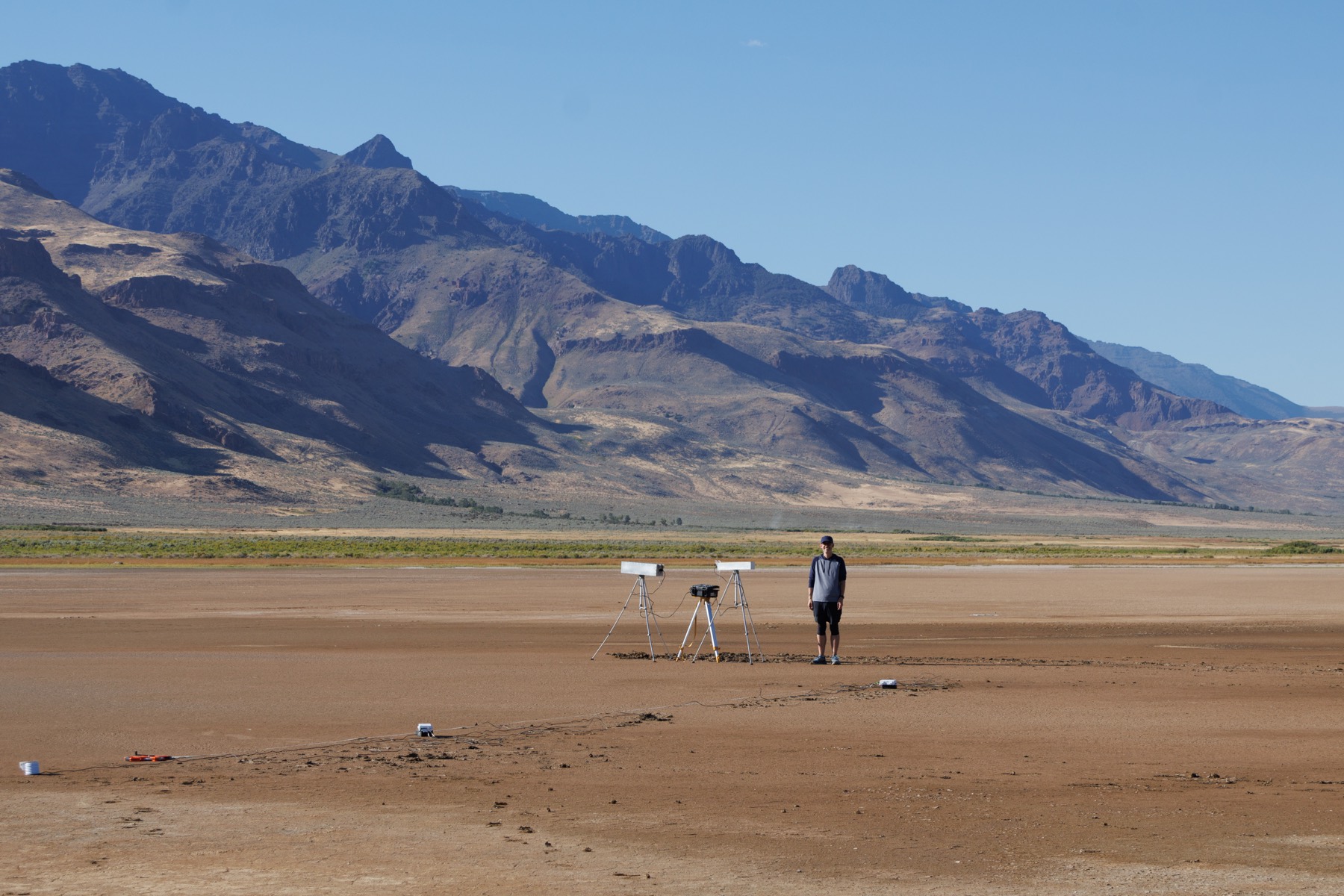
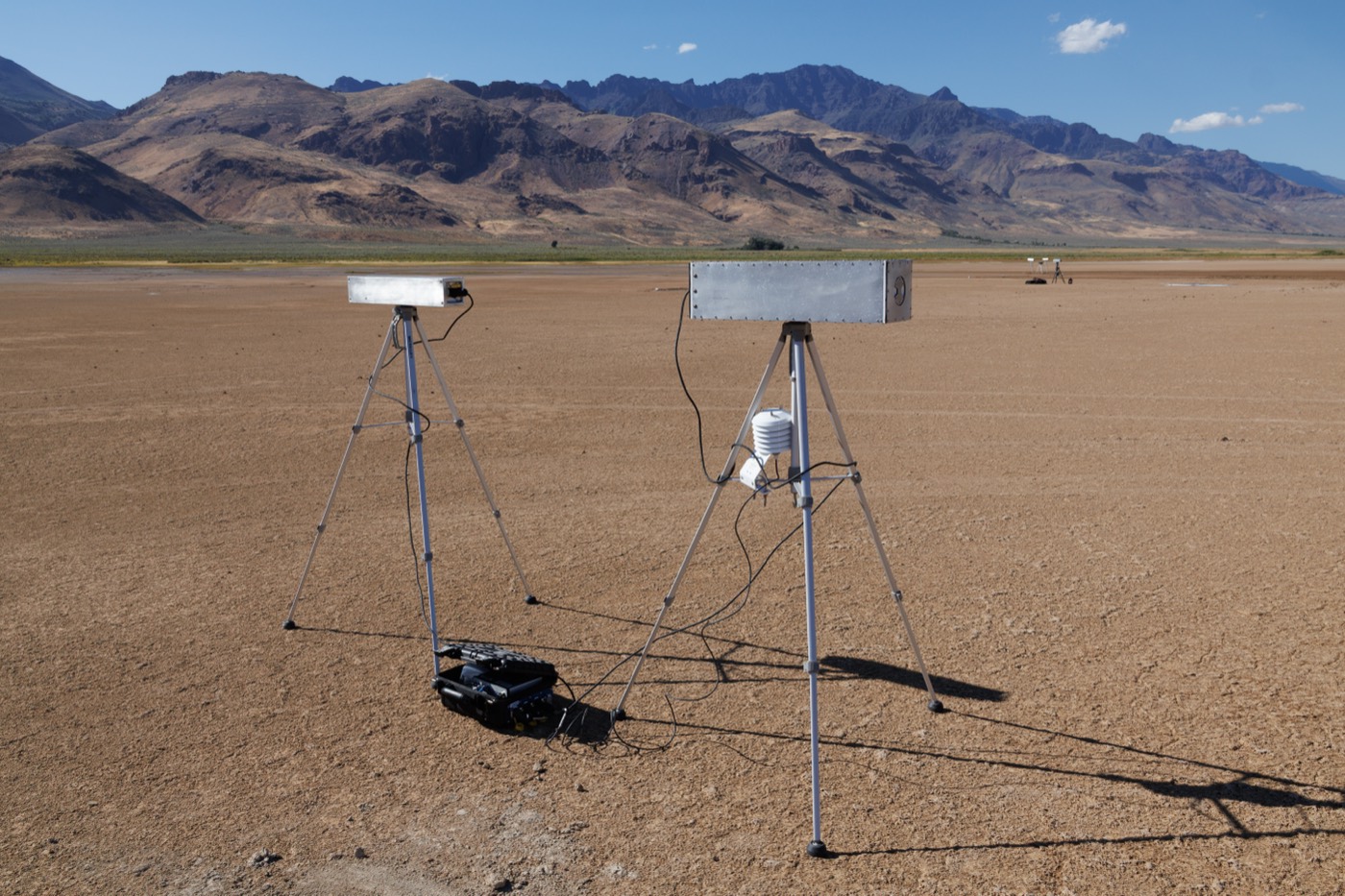
Our field-portable cosmic-ray neutron sensor (CRNS) passively counts neutrons produced by galactic cosmic rays interacting with the ground. Because hydrogen is highly effective at moderating neutrons, the count rate is inversely related to the water content of the soil within a footprint of roughly 150 to 250 meters radius and a sensing depth of tens of centimeters. The system pairs a moderated detector (sensitive to epithermal neutrons) with a bare detector (sensitive to thermal neutrons), the same measurement principle used by orbital and landed planetary neutron spectrometers from Lunar Prospector and Mars Odyssey to the DAN instrument on the Curiosity rover.
The full system packs into two detector modules totaling about 23 kg, runs on internal batteries, and logs GPS, temperature, and pressure alongside the neutron data. For campaigns requiring air travel, we worked with Quaesta Instruments to build a smaller carry-on-portable version around He-3 proportional counters.
Field Campaigns
NASA MSFC Lunar Terrain Field, Alabama
June 2026
CRNS depth-sensitivity test at the regolith test field at NASA Marshall Space Flight Center, run alongside a joint neutron and seismic experiment campaign with NASA MSFC and partner institutions.
Namib Sand Sea, Gobabeb, Namibia
October 2025
A NASA-funded deployment based at the Gobabeb Namib Research Institute, carried out as part of the Dragonfly mission analog field campaign. We measured neutron count rates across a full dune profile (dune crest, slopes, base, and interdune) as a Mars dune analog for comparison with Mars Odyssey orbital and MSL DAN surface neutron data. The measurements resolved clear differences in near-surface moisture between geomorphic units of the sand sea, with interdune surfaces distinctly wetter than the extremely dry dune crests. Collaborators include BYU, the University of Idaho, the University of Nebraska-Lincoln, the Gobabeb Namib Research Institute, and the University of Basel.
Alvord Playa, Oregon
August 2025
Deployment on the Alvord Desert playa as part of a NASA PSTAR field campaign investigating habitable environments. Wet and dry playa sites showed clear contrast in neutron count rates and derived soil moisture, demonstrating the sensitivity of the technique across hydrologic gradients.
San Francisco Volcanic Field, Arizona
Published 2026
Radiochemical mapping of silicic-to-basaltic volcanic terrains with a portable gamma-ray and neutron detector, constraining Si, Fe, and Th abundances as a lunar analog study for discriminating volcanic lithologies, directly relevant to the Lunar-VISE investigation of the Gruithuisen Domes. Published as Ölçek et al. (2026) in Icarus.
Earlier Deployments
2022 – 2024
Jornada Experimental Range, New Mexico (July 2022): rover-integrated mobile CRNS surveys. Lake Pleasant, Arizona (May 2024): stationary soil-moisture calibration measurements.
Related Publications
- Ölçek, D., Hardgrove, C., et al. (2026). Lunar analog study using portable gamma-ray neutron detector: Radiochemical mapping of silicic-to-basaltic volcanic terrains in the San Francisco Volcanic Field, Arizona. Icarus 456, 117131.
- Gonzales, N. (2024). Experimental determination of the spatial sensitivity of a He-3 neutron spectrometer for field analog experiments to reunite planetary science and terrestrial hydrology. MS Thesis, Arizona State University.
- Hurtado, R. (2024). Landscape position impacts on the water balance in the Chihuahuan Desert. MS Thesis, Arizona State University.